
International · Republic of Korea
Busan & Gyeongju — Korea Beyond Seoul
Sea, city and old kingdoms — begin with Busan’s working coast and markets, then slow down among Gyeongju’s Silla landscapes and living heritage.
Begin with Busan’s working coast, markets and neighbourhoods, then change pace in Gyeongju, where royal tombs and Silla heritage remain part of a living city. Two places, two rhythms, and a broader way into Korea.
Start with the sea
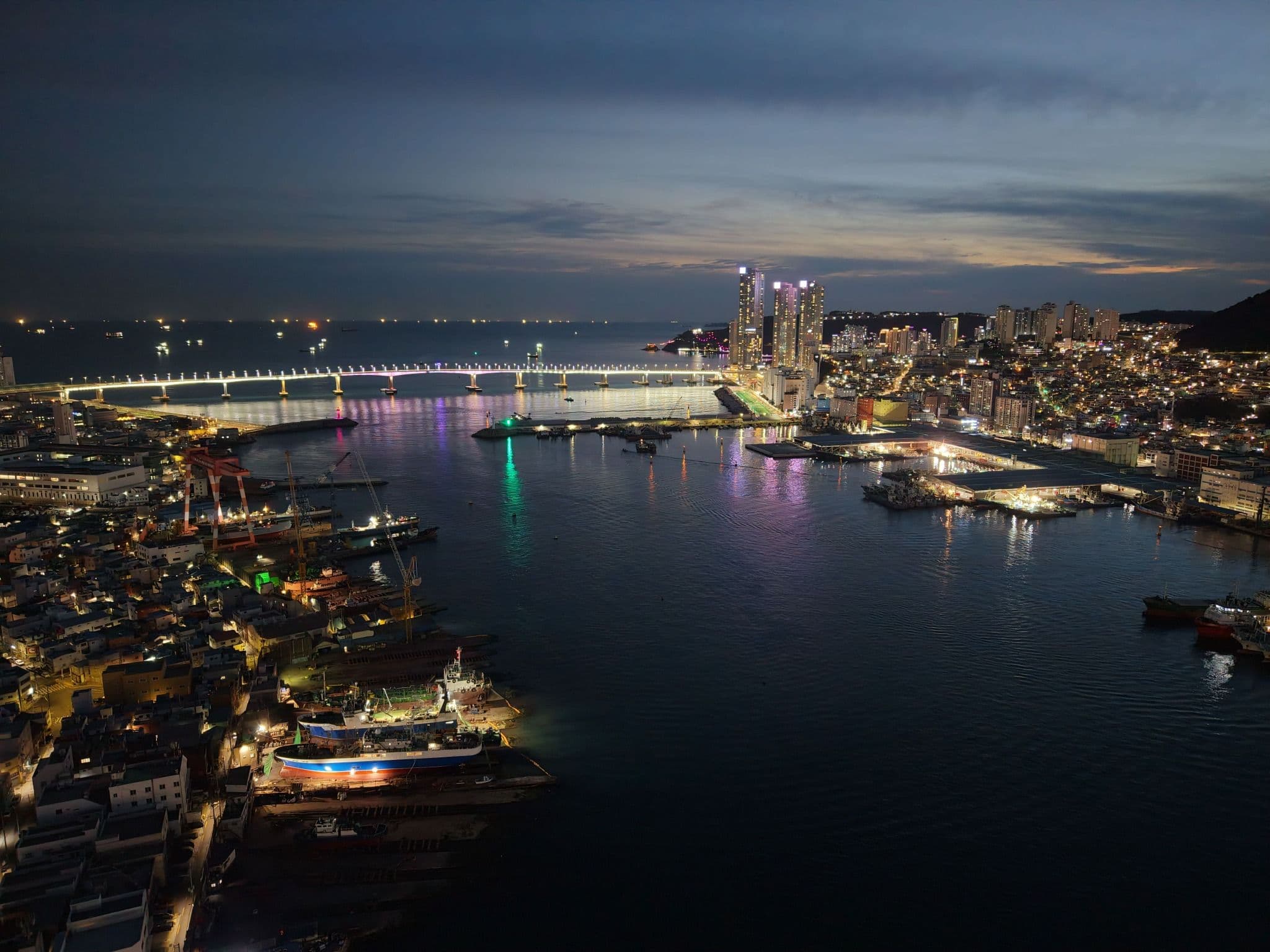
Busan makes sense when the sea is treated as part of the city rather than as scenery beyond it. Water appears beside apartment towers and bridges, beside markets, fishing activity, neighbourhood streets and long stretches of coast. It changes the light, the food and the way districts face outward.
That is why this journey should not begin with a list of beaches. A traveler can certainly spend time by the water, but Busan becomes more interesting when the coast is read as infrastructure and livelihood as well as leisure. The city is not simply beside the sea; much of its character has been shaped in conversation with it.
Busan: a city that works at the water’s edge
Old downtown gives that relationship a human scale. Around Jagalchi and the neighbouring commercial streets, seafood is traded, prepared and eaten within sight of the harbour. The market’s history is also tied to the upheavals that shaped modern Busan, including the arrival of refugees during and after the Korean War. That history deserves recognition without turning hardship into nostalgia.
From there, the city can unfold according to interest rather than a mandatory route: a neighbourhood that climbs away from the waterfront, an evening beside a bridge-lit bay, a quiet edge of Yeongdo, or a meal that makes more sense because the morning was spent watching how seafood moves through the city.
The point is not to prove that Busan has “more” than another Korean city. It is to notice the particular way its geography, markets and everyday movement fit together.
The transfer is part of the story
Busan and Gyeongju are close enough to pair naturally, with rail and road connections making the movement between them practical. Exact schedules and journey times belong to current planning, not evergreen storytelling. What matters editorially is the change of register.
Leave a city built around hills, harbour and open water, and arrive somewhere where the landscape begins to hold a different kind of memory. The transition is not a dead hour between attractions. It is the hinge of the journey.
Gyeongju: history spread through a living city
Gyeongju is often introduced through its monuments, but the deeper idea is spatial. UNESCO’s Gyeongju Historic Areas bring together royal tombs, palace and temple remains, Buddhist art, mountain sites and defensive landscapes that testify to the cultural achievements of the Silla dynasty. Silla endured for nearly a thousand years, and Gyeongju served as its capital.
That history is not contained inside one museum wall. Grassy burial mounds rise within the modern city. Former royal landscapes sit near roads, cafés and neighbourhoods. Archaeological remains and contemporary life occupy the same urban frame. Walking through Gyeongju can therefore feel less like moving from one attraction to the next and more like learning how to read layers in the ground.
Bulguksa Temple and Seokguram Grotto add another dimension when they genuinely fit the journey. Together they form a separate UNESCO World Heritage property associated with 8th-century Silla Buddhist art and architecture. They are important, but they do not need to carry the entire story of Gyeongju.
Leave room for the present
A city with this much heritage can easily be described as if time stopped centuries ago. Gyeongju is more interesting when that language is resisted. People still live, work, study, eat and meet here. Streets near the historic areas have developed their own contemporary café, food and design culture; museums continue to interpret new findings; excavation and conservation remain active processes rather than completed history.
This matters for the traveler. A good Gyeongju day is not necessarily the one that contains the highest number of monuments. It may be the one that gives a royal-tomb landscape enough space to register, then allows time for a neighbourhood meal, a museum, or simply the change in atmosphere after dark.
Experience heritage without turning it into a backdrop
Historic places carry rules as well as beauty. Temple grounds remain religious spaces. Archaeological sites require protection. Tomb landscapes and museum objects are not props for a themed version of the past.
Follow current visitor guidance, respect restricted areas and photography rules, and resist the temptation to treat every traditional-looking street as a stage set. When local interpretation is available, it can make a large difference: a stone foundation, mound or pagoda often becomes more meaningful once its relationship to the wider Silla capital is understood.
Shaping the journey
The Busan–Gyeongju pairing works best when neither city is reduced to a day-trip appendix. Busan needs enough time for the waterfront and neighbourhoods to feel connected; Gyeongju benefits from enough space to move between heritage and present-day city life without racing through a checklist.
The practical shape can vary. Rail may suit one traveler, road another. A stay near the sea may matter more than nightlife; another traveler may want food markets, contemporary art, Buddhist heritage or archaeology to lead. Seasonal weather and opening arrangements can also change the sensible sequence.
That is where planning becomes useful: not in forcing two cities into a fixed template, but in deciding what kind of contrast you want the journey to reveal.
Another way into Korea
Busan and Gyeongju do not need to compete with Seoul to justify the journey. They offer something different.
Busan begins with movement: coast, market, bridge, neighbourhood, food. Gyeongju slows the eye down: tomb, stone, palace ground, temple, museum, street. One looks outward to the water; the other asks you to notice what has accumulated through time.
Together they make a journey with two distinct rhythms — sea, city and old kingdoms — and a broader way to understand Korea beyond a single urban centre.
A journey concept is inspiration and a planning starting point. It is not a confirmed itinerary, fixed package, guaranteed departure, or confirmed fare — we shape the details together.