
Indonesia · East Java
Ijen Before Dawn
Climb into the dark, then watch Ijen reveal itself — volcanic slopes, crater lake, sulfur and the first light of East Java.
Climb into the dark, then watch the landscape reveal itself: volcanic slopes, a crater lake, sulfur, work and the first light over East Java. Ijen is more compelling when the night is the beginning of the story, not the whole reason for going.
Before the landscape appears
Ijen begins before you can properly see it. The road rises into the highlands while the surrounding slopes are still dark, and the first part of the walk is often reduced to what sits inside a headlamp’s beam: a bend in the path, damp ground, the outline of trees, another few metres uphill.
That limited view is part of the experience. A pre-dawn ascent changes the way the landscape is understood. Temperature, gradient, sulfur in the air and the movement of other people register before the scale of the crater does. Then the light begins to change, and a volcanic landscape that had been mostly imagined starts to take form.
For LAKSANAVA, that transition is the heart of this journey. Ijen is famous for blue fire, but a thoughtful visit should not depend on one phenomenon appearing on command.
More than blue fire
The blue flames associated with Ijen are real, but they need careful language. They are linked to sulfur-rich gases that ignite, and their visibility depends on darkness, environmental conditions and whatever access and safety rules are in force at the time of a visit. They are not a performance with a guaranteed start time.
Building the entire journey around a promised sighting turns a complex place into a single photographic target. A better approach lets blue fire remain one possible part of a larger encounter. The darkness, the climb, volcanic geology, crater lake, sulfur-working landscape and arrival of daylight all have meaning of their own.
A landscape shaped from below
Ijen sits within a much larger volcanic territory at the eastern end of Java. UNESCO designated Ijen as a Global Geopark in 2023, recognising a landscape whose geological significance extends beyond the crater itself. Thinking at that scale helps explain why the journey should not feel like a race to one viewpoint.
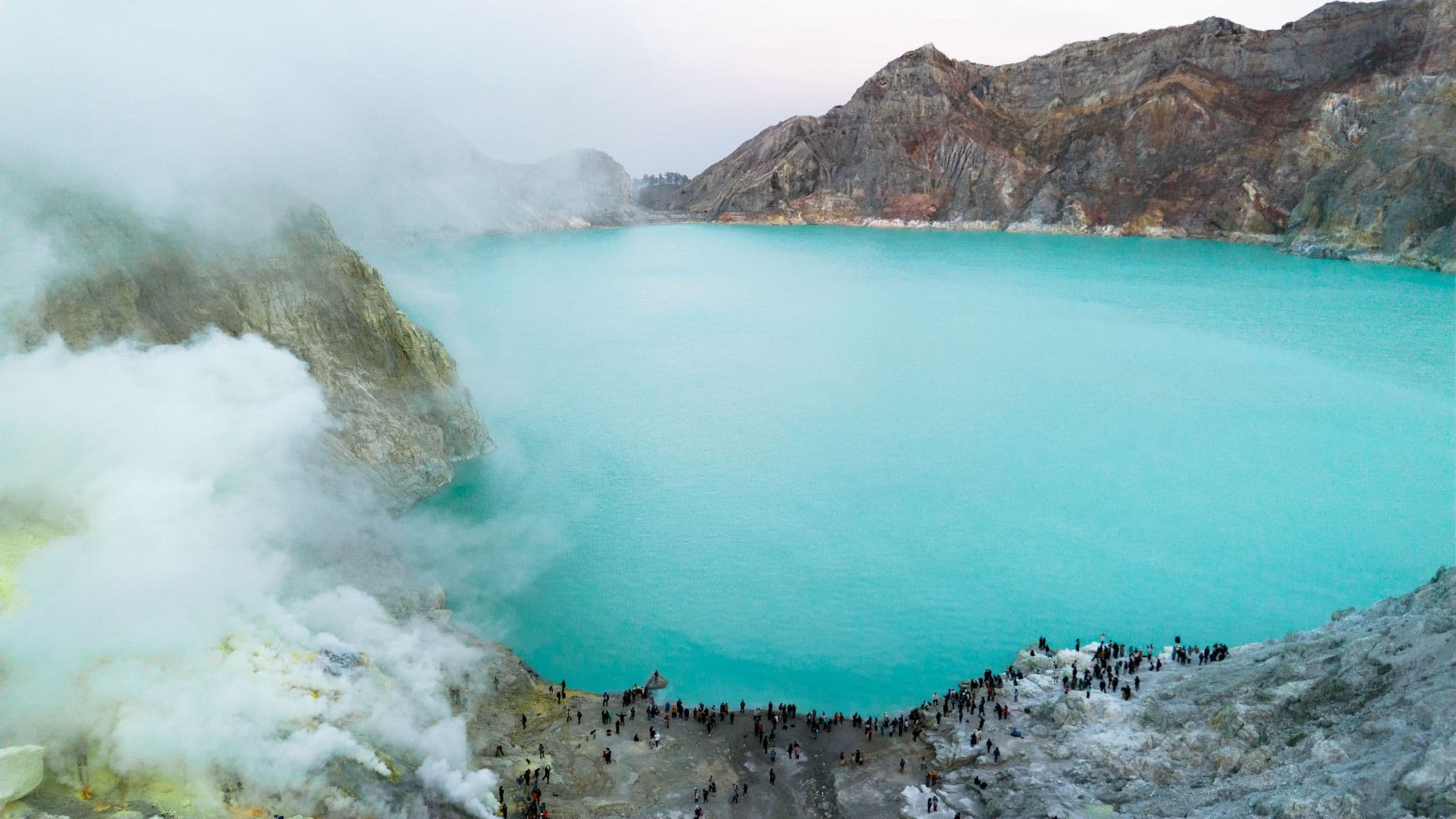
At the crater, geology becomes unusually tangible. The colour of the lake, exposed rock, vents and sulfur deposits make the forces beneath the surface easier to imagine. Yet an active volcanic landscape also demands humility. Current instructions from responsible authorities matter more than an old itinerary, an online video or a traveler’s previous experience.
The human landscape
Ijen is not empty terrain. Sulfur workers have long been part of the landscape around the crater, carrying out physically demanding work in an environment visitors encounter only briefly.
Their presence deserves context rather than spectacle. Give space on the trail, follow local guidance, ask before making close portraits, and avoid turning hardship into a dramatic travel prop. Banyuwangi and Bondowoso are also more than gateways crossed in the dark; allowing the journey to extend beyond the crater creates a fuller sense of place.
When daylight changes the journey
One of Ijen’s most satisfying moments can be remarkably simple: being able to see where you have been. As dawn develops, ridgelines separate from the sky and the scale of the crater becomes clearer. The walk back can feel like a second journey along the same path because the landscape is now legible in a different way.
This is also why sunrise should not be sold as a guarantee. Cloud, mist, rain and volcanic conditions are part of mountain travel. The value lies in witnessing the transition when conditions permit it, not in promising a particular photograph at a particular minute.
Planning Ijen thoughtfully
A pre-dawn Ijen journey asks more of the traveler than an ordinary sightseeing stop. It involves an unusually early start, uphill walking, cool highland conditions and an active volcanic environment. The right plan should therefore begin with the traveler, not with a fixed departure template.
Fitness and mobility matter. So do current health and access requirements, weather, volcanic advisories, opening arrangements and permitted visitor zones. These details should be checked close to travel rather than copied permanently into an inspirational article.
Ijen can be approached within a journey shaped around Banyuwangi, Bondowoso or a broader passage through East Java. Arrival and onward movement can influence whether the experience feels rushed or considered.
Access, safety controls, health requirements, permitted zones and operating arrangements can change. Verify current official conditions for the intended travel date.
Let the morning be bigger than the photograph
Ijen rewards curiosity more than certainty. Go because you want to understand a volcanic landscape in transition from night to day, not because the mountain has been asked to deliver one guaranteed spectacle.
Begin in darkness. Pay attention to the climb. Read the geology. Respect the people whose workplace intersects with your route. Let daylight reveal what the night concealed.
That is the journey LAKSANAVA would shape: not a race for blue fire, but a morning with enough context to make Ijen memorable even after the darkness has gone.
A journey concept is inspiration and a planning starting point. It is not a confirmed itinerary, fixed package, guaranteed departure, or confirmed fare — we shape the details together.