
Indonesia · Central Java & Yogyakarta
Solo to Yogyakarta — A Journey Through Living Java
Two cities shaped by related histories, yet distinct in rhythm. Move from Solo’s courts, markets and batik neighbourhoods to Yogyakarta’s palace axis and creative streets, with the journey between them part of the story.
Two cities shaped by related histories, yet distinct in rhythm. Travel from Solo’s courts, markets and batik neighbourhoods to Yogyakarta’s palace axis and creative streets, with the journey between them part of the story.
Two cities, not one cultural shorthand
Central Java is easy to compress into famous names: a palace, a temple, a market, a plate of food, then onward. Solo and Yogyakarta reward the opposite approach. They sit close enough to be joined naturally, yet the interest lies in noticing where their rhythms diverge — in court traditions, street life, craft, architecture and the way each city carries history into the present.
Their relationship is not accidental. In 1755, the Treaty of Giyanti divided the Mataram realm into Surakarta and Yogyakarta. An official Yogyakarta Palace account also records the Jatisari meeting that followed, when the two courts began articulating distinct cultural identities. Mangkunegaran emerged in Surakarta two years later, in 1757. These dates are useful not as a history lesson to memorise, but as a clue for the traveller: Solo and Yogyakarta share roots without being interchangeable.
That makes the journey between them richer than a simple transfer. You are moving through a cultural landscape in which related traditions took different forms and continue to be practised, adapted and debated today.
Solo: begin with the quieter details
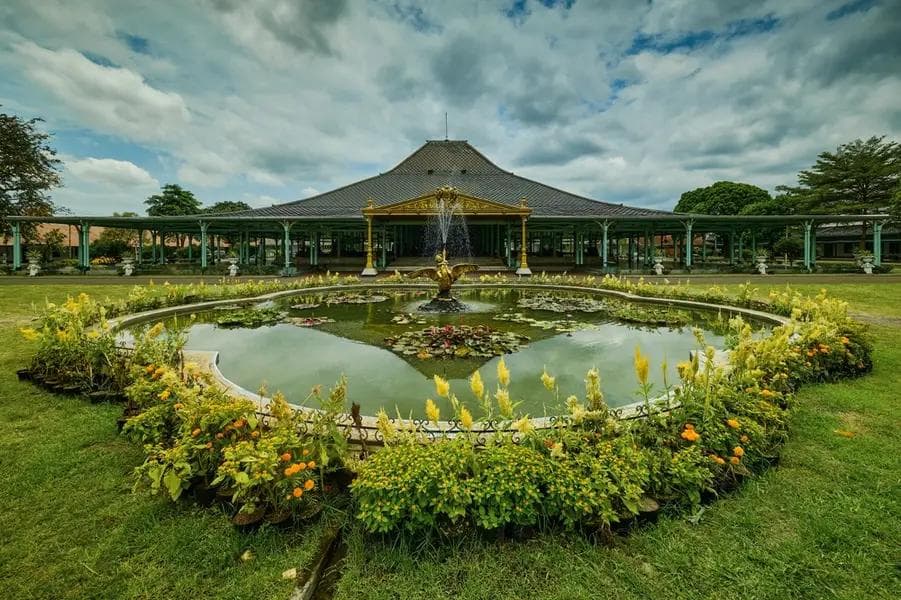
Solo — formally Surakarta — often reveals itself without demanding attention. A morning can begin around Pura Mangkunegaran, where architecture, court history, music and performance traditions are still connected to a living institution. The value of a visit is not in treating the palace as a decorative backdrop, but in listening to the context offered by its guides and observing the protocols of a place that still carries cultural meaning.
From there, the city becomes more interesting when the boundary between ‘heritage’ and everyday life starts to blur. In Laweyan and Kauman, batik is not only something displayed behind glass; these are neighbourhoods with long craft histories that continue through workshops, businesses and family knowledge. Indonesian Batik itself is recognised by UNESCO as intangible cultural heritage, but the more useful traveller’s question is smaller: who made this cloth, how was it made, what does the pattern mean here, and when is a motif appropriate to wear?
Markets add another register. Around Pasar Gede and other trading streets, food, commerce and social life bring the city back to the present tense. Rather than trying to ‘cover’ Solo, leave room to follow a conversation, return to a stall, watch a craft process properly, or simply notice how courtly references and contemporary city life sit beside one another.
The journey between cities matters
Solo and Yogyakarta can be linked by rail, and official commuter services connect stations in both urban areas. A direct train keeps the transition simple and lets the changing density outside the window mark the shift from one city to the next. If the journey is shaped by road instead, the corridor opens another possibility: Prambanan can become a meaningful pause between the two cities rather than an isolated excursion.
Prambanan is best understood with some scale. The UNESCO World Heritage property includes not only the soaring Hindu temples most visitors recognise, but also associated Buddhist temple compounds such as Sewu. Seen between Solo and Yogyakarta, it can function as a hinge in the story — a reminder that Java’s cultural landscape reaches much further back than the court traditions of the eighteenth century.
It does not need to be forced into every version of the journey. Current access, operating arrangements and visitor conditions should be checked close to the date. The point is to choose the transition that suits the traveller: efficient rail if more time belongs in the cities, or a road journey if Prambanan genuinely deepens the narrative.
Yogyakarta: read the city as a cultural landscape
Yogyakarta is often approached as a collection of famous streets and landmarks. It becomes more coherent when you read the city through its structure. The Cosmological Axis of Yogyakarta and its Historic Landmarks was inscribed on the UNESCO World Heritage List in 2023. The north–south axis places the Kraton at the centre of a spatial and philosophical system that links landmarks, ritual life and ideas about the human journey.
That context changes the experience of familiar places. The Kraton is not simply an old palace: it remains a royal residence and an active centre of cultural traditions. Beringharjo is not simply a shopping stop: the market belongs to a long urban history of exchange near the palace core. Tamansari, streets around the Kraton, neighbourhood workshops and the movement of people through the centre all make more sense when the city is allowed to be lived-in rather than reduced to monuments.
Yogyakarta’s energy is different from Solo’s. There is more visible student life, tourism, contemporary art, cafés, workshops and movement. The contrast is useful. A journey that begins with Solo’s quieter scale can arrive in Yogyakarta with a stronger sense of how many versions of Javanese life coexist — courtly, neighbourhood, religious, commercial, creative and everyday.
How to experience it thoughtfully
The most rewarding version of this journey is not the one with the most stops. Give each city enough time for a second look. If a first visit to a palace explains a motif, a ritual or a piece of music, let that knowledge change what you notice later in a market or workshop. If a craftsperson is willing to explain a process, listen before reaching for the camera. Ask permission before photographing people closely, especially in working or ceremonial settings.
Dress and behaviour matter at cultural institutions, and individual sites may have specific rules about clothing, footwear, photography, guides or restricted motifs. These rules are operational information, not evergreen copy: check the institution’s current guidance before visiting. The same applies to performances, religious events and cultural calendars. A ceremony that happens to coincide with a trip is not an entitlement; participation and viewing should follow the host institution or community’s guidance.
Food works best here in the same spirit. Markets, modest local dining rooms and long-established specialities can become part of the cultural reading of a city without turning meals into a checklist. Let appetite, location and the day’s rhythm guide the choices.
Shaping the journey
There is no single correct duration or order beyond the basic logic of linking the two cities. Some travellers may want to settle into Solo first, then move toward Yogyakarta. Others may reverse the direction. Accommodation can be chosen around walkability, atmosphere and the parts of each city that matter most to you. Transfers can be kept simple, while rail can work well for a direct city-to-city move. If Prambanan is included, road planning may make the sequence more natural.
Weather, cultural calendars, traffic, rail schedules and site operations can all change the texture of a day. Those details should be verified when the journey is being shaped, rather than frozen into an article. What can remain constant is the editorial idea: do less, understand more, and let the relationship between Solo and Yogyakarta reveal itself gradually.
The lake, mountain or beach is not the anchor here. The anchor is living culture — carried in institutions, neighbourhoods, markets, food, craft and the spaces between them. Solo and Yogyakarta are close on the map, but giving both cities their own voice is what turns the route into a journey.
Planning note
This is inspiration and a planning starting point, not a confirmed itinerary, fixed package, guaranteed departure, confirmed fare, or supplier commitment. Current site rules, access and transport should be checked when the journey is being designed.
Plan This Journey — share your dates, pace and interests so the route can be shaped around you.
A journey concept is inspiration and a planning starting point. It is not a confirmed itinerary, fixed package, guaranteed departure, or confirmed fare — we shape the details together.